
Florida ADU Laws (2026): What the State Sets, What Your City Decides
It depends on your city. Florida ADU laws start with a 2004 statute, F.S. 163.31771, which lets counties and cities allow accessory dwelling units but doesn't require them to. A 2026 bill that would have required every local government to allow ADUs died in March. Last verified October 10, 2026.

Florida's ADU law
Can You Build an ADU in Florida?
Yes, if your city or county allows it. Florida's statute says a local government "may adopt" an ordinance allowing ADUs in single-family zones, but it doesn't require one. A 2026 bill that would have required ADUs statewide passed the Senate 38-0, then died on March 13 without passing the House.
Florida Housing Coalition findings, cited in a January 2026 Senate staff analysis, found that 11 of the 15 most populous cities explicitly allowed ADUs in single-family districts, and 16 of 67 counties didn't address them.
The statute also says every ADU building permit application "must include an affidavit" that the unit "will be rented at an affordable rate" to a lower- or moderate-income tenant. Ask your building department how your city applies it.
Settled vs. local
Florida's ADU Law: What's Settled, What's Still Local
The statute defines an ADU and leaves the five rules below to your city. Last verified October 10, 2026.
Work in progress: s. 163.31771
Opt-in since 2004, last amended 2020. ADUs allowed under it count toward local affordable housing plans.
Approval: left to your city
Florida law doesn't require by-right (staff-only) approval. A public hearing adds time and can end in a no.
Owner-occupancy: left to your city
The statute doesn't address it. Where a city requires it, you live on site and can't rent out both units.
Parking: left to your city
State law doesn't limit parking mandates. One extra space can make a small lot unbuildable.
ADU types: left to your city
The statute covers units inside the house or elsewhere on the lot. Your city picks which types it permits.
Size and fees: left to your city
The state caps neither ADU size nor impact fees. Those two numbers often decide whether a small ADU pencils out.
Size and design
What Are Florida's ADU Size and Design Limits?
Florida law doesn't cap ADU size. Each card shows one city's rule as an example.
Detached ADU
- No state size cap
- Example: St. Petersburg allows 800 sq ft or 67% of the existing home, whichever is less
Attached ADU
- State law is silent on size
- Example: Orlando requires it to be smaller than the main house
Lot size and setbacks
- No state minimum lot size or setback
- Example: Orlando R-1 needs a 6,000 sq ft lot for up to 500 sq ft, 9,000 sq ft for up to 1,000 sq ft
ADUs per lot
- No state rule; your zone's code sets the count
Occupancy and parking
Does Florida Require Owner-Occupancy or Off-Street Parking for an ADU?
Not at the state level. Florida ADU regulations leave both to local governments.
Owner-occupancy: left to your city
Tampa requires the main residence to be owner-occupied.
Parking: left to your city
Orlando requires one more parking space once the ADU is over 500 sq ft.
Approval
Is ADU Approval By-Right in Florida, or Does It Require a Public Hearing?
The ADU statute is silent on approval path, review deadline and fees.
Florida law doesn't require by-right approval (staff sign off, no public hearing). Your city's code sets the path for your zone.
The ADU statute puts no clock on review. Timing depends on your city's approval process and whether a hearing is involved.
The statute neither caps nor waives permit or impact fees. Budget from the city's fee schedule, utility connections included.
See an ADU on your own Florida lot
Cities like St. Petersburg tie the cap to your house size, so start from a 500 sq ft plan and check it against your city's rules.
Local rules
What Does Florida Law Still Leave Up to Your City?
Even where ADUs are allowed, these rules are local.
Selling the ADU separately
Orlando requires one owner for both units and won't let the ADU be sold separately.
HOAs and deed restrictions
The ADU statute doesn't mention HOAs, so it doesn't override your covenants. HOA sign-off is a separate approval.
Zoning overlays
Historic and overlay districts can add limits. Orlando caps ADUs at 700 sq ft in historic districts. Check your lot's overlay and flood maps.
Setbacks and lot coverage
The ADU statute sets no setback or lot-coverage rule. Your zoning code decides both.
Utilities and septic
A second unit needs water, power, and sewer or septic capacity. Check utility connections early; they can move the budget.
Short-term rentals
St. Petersburg's ADU code sets a 30-day minimum, with limited exceptions. State law limits newer local vacation-rental rules. Ask your city what applies.
Check your city
How to Check Your City's ADU Rules in Florida
Ask whether ADUs are allowed at all
Ask your city or county planning department whether your zone allows ADUs, and what the code calls them.
Get the ordinance itself
Get the ADU section of the zoning code and read the rules there, not in a summary.
Search every local term
Florida codes use accessory dwelling unit, accessory apartment, secondary suite, granny flat, guest house and extended family residence.
Check your HOA
Florida's ADU statute doesn't address HOAs. Check your covenants and ask the association before you design.
Ask about approval and fees
Ask who approves ADUs (staff or a hearing), current review times, and which impact and connection fees apply.
Bring a plan to the conversation
With a floor plan and site plan in hand, a planner can give you a yes, a no or a list of changes.
The State of Florida in the News
Pending ADU bills: none found as of October 10, 2026.
SB 48 and HB 313 (2026): both died. SB 48 would have required every county and city to allow ADUs in single-family zones without a public hearing by December 1, 2026, and barred owner-occupancy rules. It passed the Senate 38-0 on February 4, 2026, never passed the House, and died on March 13. HB 313, a similar House bill, died in subcommittee (bill history). If you've seen headlines saying Florida made ADUs mandatory statewide, the official bill records say otherwise.
What did pass: HB 1389 (chapter 2026-179, effective July 1, 2026) changed the Live Local Act and density bonuses. It has no ADU provisions (House analysis).
2025: SB 184 died in the final hour of the session over a House–Senate split on short-term rentals (WUSF).
Planning tools for Florida
How Does HomeWiP Help With ADUs in Florida?
We don't handle permits in Florida. We have 7+ years on ADUs and 700+ plans. In 20+ California cities and counties, we've run projects end to end, from design through permits and construction to final inspection. How a house is built and hooked up to utilities is much the same; in Florida, your city's permit rules and building codes still change the design.
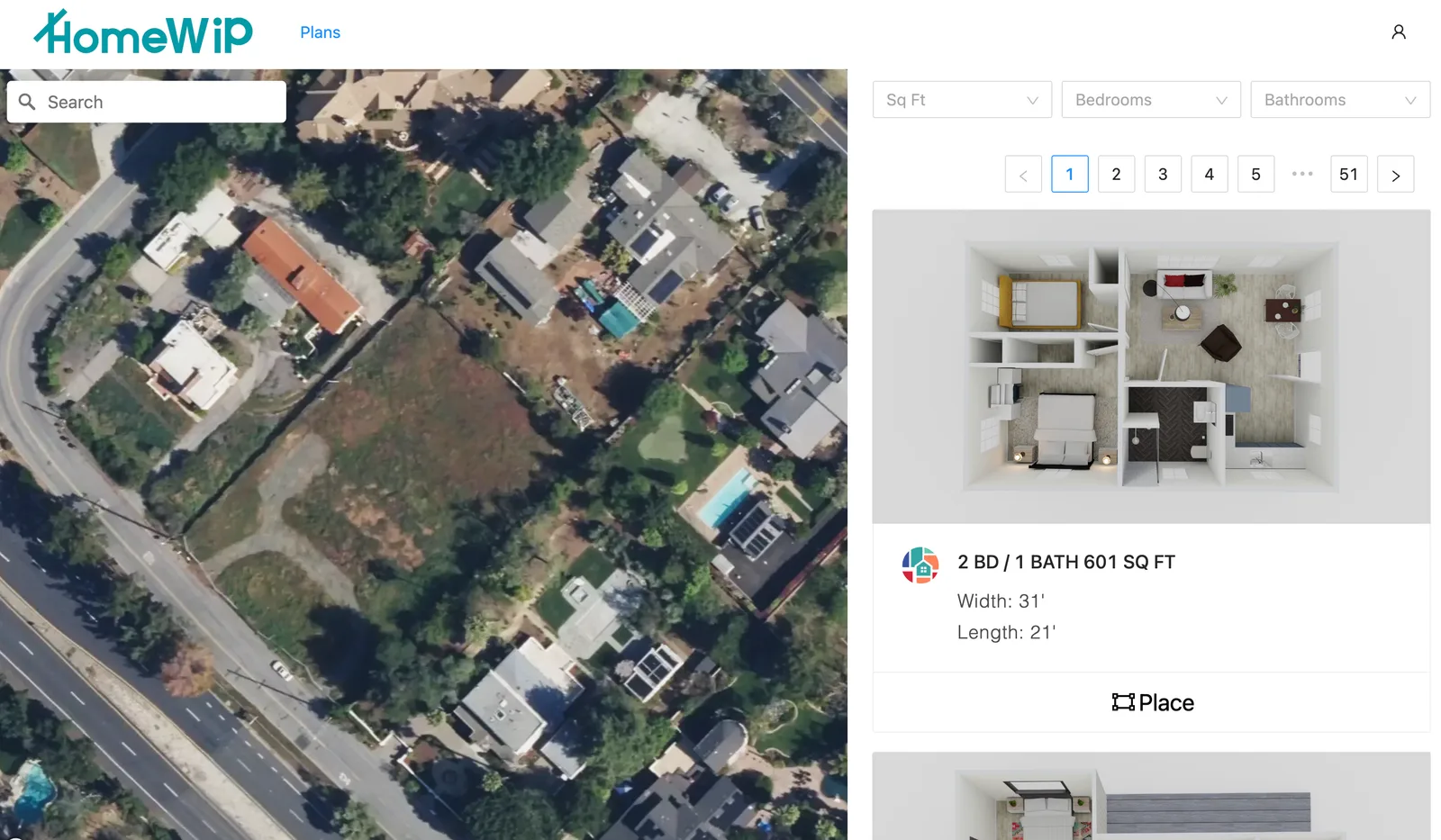
- View pre-designed plans in your backyard
Pick a free plan, then place it
Choose a pre-designed floor plan on adu.homewip.com. The next step, the site visit tool, places it on your Florida lot.
- Contact HomeWiP
Take the plan to your city
Bring the plan and site layout to your planning department. Questions about our plans or tools? Contact us. We don't handle Florida permits.
FAQ
Florida ADU Laws: Frequently Asked Questions
It depends on your city. Florida's ADU statute lets local governments allow ADUs in single-family zones but doesn't require it. SB 48, the 2026 bill that would have required every county and city to allow them, died on March 13, 2026.
Not under state law, but your city may require it. Tampa requires the main residence to be owner-occupied; St. Petersburg doesn't. For short-term rentals, St. Petersburg's ADU code sets a 30-day minimum with limited exceptions, and state law limits newer local vacation-rental rules, so ask your city what applies.
Possibly. Florida's ADU statute doesn't mention HOAs or deed restrictions, so it doesn't override your covenants. A city permit and HOA approval are separate; if you have an HOA, you may need both. The covenant clauses to look for cover second units, guest houses and rentals.
There's no statewide answer, because Florida's ADU statute has no review deadline. Timing depends on your city's approval process, whether your ADU needs a public hearing, and how complete your application is. Where staff approve ADUs without a hearing, that step drops out.
Florida law sets almost no floor. The statute defines an ADU and lets local governments allow them. It also says the permit application must include an affordable-rent affidavit; ask your building department how that applies. Approval process, owner-occupancy, parking, size, fees and setbacks are your city's call.
Often, yes. Florida's statute says accessory dwelling unit, but the same structure can be an accessory apartment, secondary suite, granny flat or guest house, and in Tampa an extended family residence. Search your city's code for each term before you decide it has no ADU rules.
It can. The part you live in keeps the exemption, but a rented ADU is assessed separately. Renting all or substantially all of the homestead counts as abandonment. An ADU for your or your spouse's parent or grandparent aged 62+ may qualify for a reduction of up to 20% of assessed value. Apply to your county property appraiser before March 1, and confirm with them before you rent or build.
Plan Your Florida ADU With a Free Pre-Designed Plan.
Start planning
Your city writes the rules, so walk in with a plan. Choose a free plan on adu.homewip.com, then place it on your lot with the site visit tool. Start around 500 sq ft while you confirm your city's cap and lot rules.
Sources
- F.S. 163.31771, Accessory dwelling units
- SB 48 (2026) bill history, Florida Senate, used because no current state agency ADU guide was found
- Mercatus Center, ADU law taxonomy (2025), which doesn't classify Florida
- Last verified: October 10, 2026