
ADU Build Cost: What You Should Spend, Not What It Costs
ADU build cost runs $100K-$460K. The better question is your budget ceiling: your home's price per square foot times the ADU size you plan.
ADU build cost in California runs from about $100,000 for a garage conversion to $460,000 or more for a large detached unit, where $300,000 to $450,000 is typical, all of it builder-published rather than survey data. The spread is that wide because the price is set by your lot and your contractor, not by the ADU.
One thing up front: what follows is food for thought, not financial advice. The ranges here come from builders who sell ADUs, and the value math is a rule of thumb rather than an appraisal.
What an ADU build costs in 2026, by type
By type, builders publish $50,000 for a junior unit and $460,000+ for a large detached build. Read every figure below as an opening position from a firm that sells ADUs.
- JADU (within the house): typical total $50K–$100K.
- Garage conversion: typical total $100K–$245K; typical $150–$350 per sq ft.
- Attached: typical total $160K–$300K; typical $200–$350 per sq ft.
- New detached: typical total $200K–$460K+; typical $350–$600+ per sq ft.
Construction method moves these rows less than you would think: prefab or framed on site, the ranges are the same. The expensive part happens on your lot either way, and one San Diego design-build firm, which prices by line item, puts basic sitework and general conditions at $35,000 before the vertical build. Geography moves all of it too: one Southern California builder puts Los Angeles County 15–25% above the state average, Orange 10–20%, Ventura 5–15%.
Published ranges also age badly. The same San Diego firm puts cost growth at 44% from January 2021 to December 2025: a $300,000 ADU quoted in 2021 is roughly $430,000 today.
National averages do not survive California either. One widely cited guide puts building permits at "around $1,350 nationally". That San Diego firm's city-by-city schedule puts permit fees alone at $2–$4 per square foot in Encinitas and $13–$28 in the City of San Diego. On a 700 sq ft unit, that is $1,400 against $19,600. Start with what an ADU permit actually costs and your city's fee schedule.
Why cost per square foot goes up as the ADU gets smaller
Because a 400 sq ft ADU and a 1,200 sq ft one both need a kitchen, a bathroom, utility connections and a permit set. Builder estimates put those fixed costs around $60,000 on a 400 sq ft unit against around $80,000 on a 1,200 sq ft unit. A third more money, spread over three times the floor area.
So a dollars-per-square-foot figure quoted without a size attached tells you nothing, and compact detached builds sit at the top of the San Diego firm's $375–$600+ per square foot range, not the bottom. Going smaller saves less than most homeowners expect.
The floor is legal, not economic: California bars a local agency from setting a minimum size that would prohibit an efficiency unit, as small as 150 sq ft. The economics bite long before that.
What actually moves your number
Your lot, the contractor you choose, and your finishes, in that order. Most homeowners spend their planning energy on the third one.
Your lot decides more than your floor plan
Soil, slope, how far utilities have to run from the main house, access for equipment, whether your electrical panel has room. None of it shows up in a floor plan; all of it gets priced after someone walks the property. One cost guide puts utility runs alone at $14,000 or more. This is the category behind the phone call three weeks into the job, and why the five steps of an ADU build start with feasibility.
Your size choice crosses a fee line at 750 sq ft
At 750 sq ft of interior livable space or less, an ADU is exempt from impact fees charged by local agencies, special districts and water corporations. Go above 750 and those fees are charged proportionally, ADU square footage against the primary dwelling's. A JADU gets the same exemption at 500 sq ft or less. An ADU built from existing space, and any JADU, also cannot be billed as a new residential use for utility connection fees or capacity charges, and any charge has to be proportionate to the burden. The fee decision gets made the afternoon you pick a size, not when the invoice shows up. Worth reading first: ADU plans and the 750 sq ft fee line.
Your finishes are the smallest lever you think is the biggest
The San Diego firm's breakdown puts sitework and structure at about 94% of project cost and plans plus permits at roughly 6%. Finishes, HVAC and custom design sit inside that share and move it less than a showroom visit suggests.
The question the cost guides skip — what should you spend?
Roughly your home's own price per square foot times the ADU square footage you are planning. That is what our calculator estimates the ADU adds, and it is the ceiling your budget should stay under.
Worked example from the calculator: a home at $417 per square foot with a 600 sq ft ADU returns about $250,000 of value added. The do-not-exceed budget sits below that, with a 20% cushion because overruns are ordinary; one longer cost guide recommends a 10–20% contingency for the same reason.
Here is what happens to that $250,000 at different spend levels:
- $100,000 spend: $250,000 value added, net +$150,000, break-even 4.7 yr — calculator verdict Smart.
- $150,000 spend: $250,000 value added, net +$100,000, break-even 7.1 yr — calculator verdict Smart.
- $200,000 spend: $250,000 value added, net +$50,000, break-even 9.5 yr — calculator verdict Tight.
- $240,000 spend: $250,000 value added, net +$10,000, break-even 11.4 yr — calculator verdict Risky.
- $300,000 spend: $250,000 value added, net −$50,000, break-even 14.2 yr — calculator verdict Risky.
The bottom two rows are the point. At $300,000 on this home, the ADU loses $50,000 on paper and takes 14.2 years to break even. That is an ordinary builder quote for a detached unit, and the wrong quote for this house. Run the same 600 sq ft plan against a 3,000 sq ft home worth $2.4M: at $800 per square foot the calculator returns about $480,000 of value added, and that same $300,000 lands back in the smart column.
The model has a limit: it is a rule of thumb, not an appraisal. An appraiser may not credit your ADU at the main house's per-foot rate, particularly in a neighborhood with few ADU comparables, and a lender may read the property differently again.
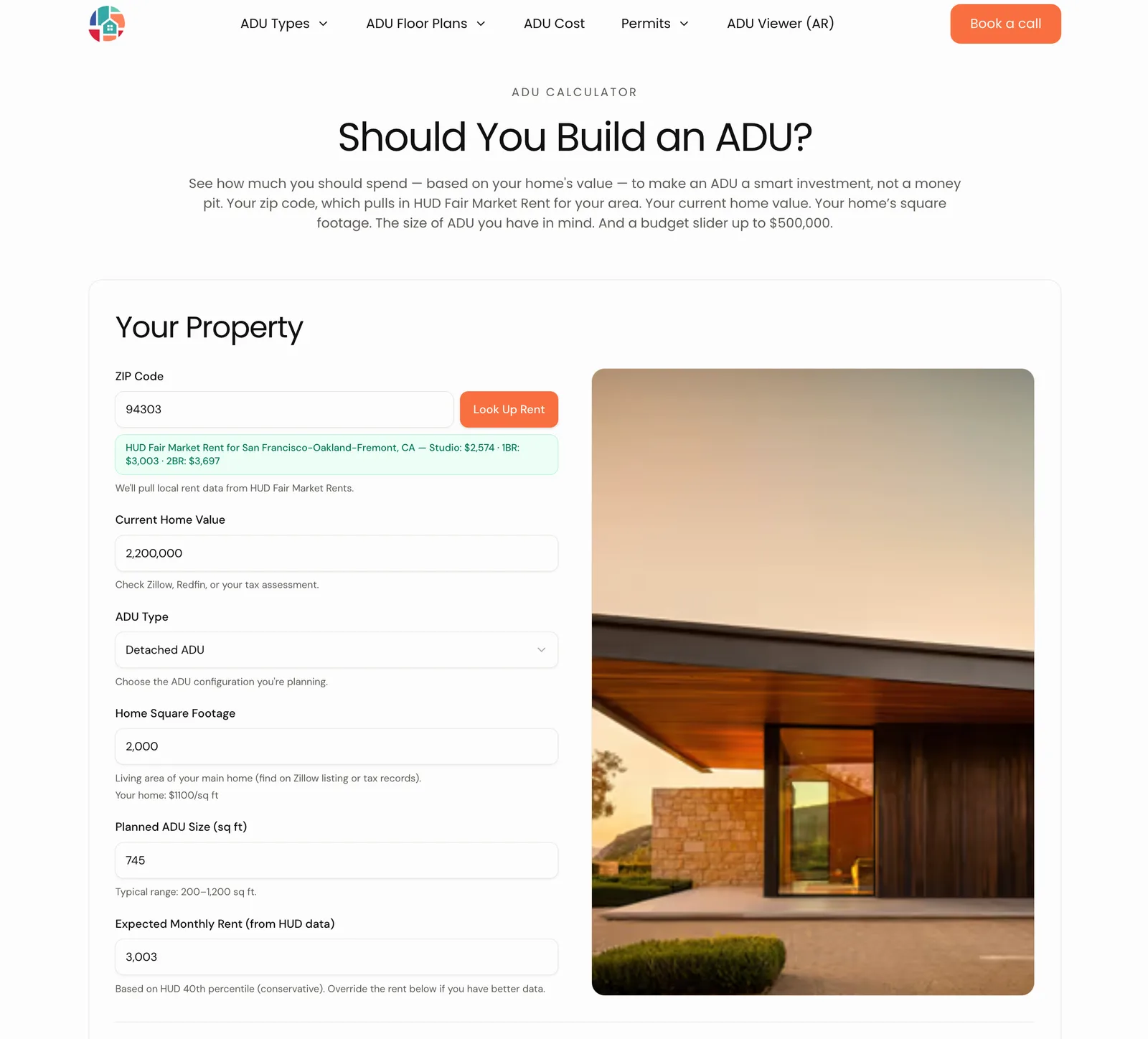
Run it on your own numbers with the ADU build cost and ROI calculator, which pulls HUD rent for your ZIP and plots your budget against your ceiling. What it gives you is food for thought, not financial advice: estimates built on builder-published ranges and a value model no appraiser has signed.
Where the rent number comes from, and what it isn't
The calculator fills expected rent from HUD Fair Market Rent for your ZIP code. FMR is a program benchmark, not a market forecast, and that difference matters before you underwrite anything on it.
HUD calculates FMRs annually as its best estimate of the 40th percentile of rents paid by recent movers, renter households that moved within the past 15 months. They set operating parameters for HUD assistance programs, most visibly Section 8 voucher payment standards, and include tenant-paid utilities except telephone, cable and internet.
Then the haircut: net annual rent applies 20% for vacancy and expenses, so $2,200 a month is $21,120 a year, not $26,400.
Rent is not the only reason to build. Put adult children, a parent or a home office in it and the rent line goes to zero in a family budget, which leaves only the value-added side of the model. We cannot account for any sentimental value - be it saving on assisted living costs or having grandkids close by. This will pull the weights for sure.
The cost guides ranking for this search skip the next rule entirely. ADUs created under Government Code § 66323, and JADUs, may not be used as short-term rentals, and any rental term has to be longer than 30 days. Nightly-rate math does not apply here. California also no longer permits owner-occupancy requirements for ADUs, with one exception: a JADU still requires owner-occupancy where it shares sanitation facilities with the primary structure.
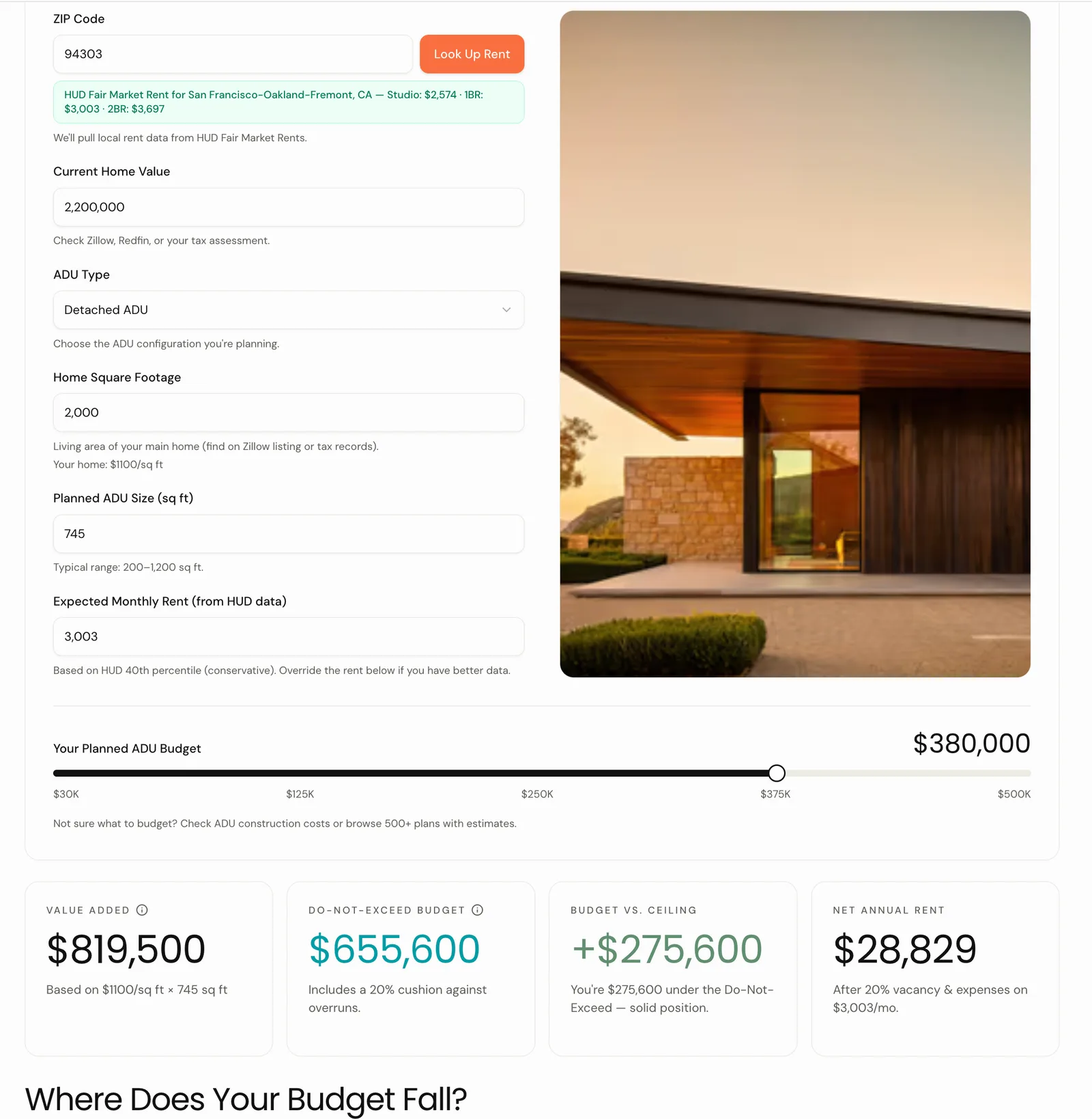
The right question to ask first
Should you build an ADU?
As a real estate investment project, an ADU should have a good ROI. Everybody starts with a question: How much will an ADU cost? We suggest starting with a question: What is a number that I should not exceed?
What financing does to the math
It moves the break-even by years, and on a tight budget it is where the case falls apart. Our financing panel models a $200,000 loan three ways: 7.0% over 30 years is $1,331 a month, with rent taking 22.7 years to pay it off; 8.5% over 20 years is $1,736 and 19.7 years; 9.5% over 15 years is $2,088 and 17.8 years. All three come back as weak ROI on those inputs.
One provision changes who can build. Under FHA Mortgagee Letter 2023-17, with no rental history on the property, the lender uses 75% of the lesser of the appraiser's fair market rent or the lease, and ADU rental income may not exceed 30% of total monthly effective income on a one-unit property. For the products themselves, home equity loans, cash-out refinancing and construction loans, see ten ways to finance an ADU.
A 10-minute version of this decision
Four steps before you call anyone:
- Find your home's price per square foot: current value divided by living area.
- Multiply it by the ADU size you have in mind. That is your rough value added.
- Take 20% off for overruns. That is your rough do-not-exceed budget.
- Compare it against real quotes, not published ranges.
The ADU build cost and ROI calculator runs it with your ZIP's HUD rent. Still deciding whether to build at all? Stay, sell, renovate, or build is the wider question; if step three came back tight, converting a garage is usually the cheaper answer.
Frequently asked questions
Builders publish roughly $50,000–$100,000 for a JADU and $160,000–$300,000 attached, $100,000–$245,000 for a garage conversion and $200,000–$460,000+ for new detached. A per-square-foot number quoted without a size attached is not usable, because small units cost more per foot than large ones.
Your home's price per square foot times the ADU's square footage. A house at $417 per square foot with a 600 sq ft ADU comes to about $250,000. That is our calculator's estimate, not an appraisal: an appraiser may not credit the ADU at the main house's rate where comparables are thin.
Yes, but only on the new construction. It establishes a new base year full value for that portion of the property only, and the pre-existing property's base year value is not changed. Total taxable value becomes the ADU's full value added to the existing taxable value.
Partly. Under FHA Mortgagee Letter 2023-17, with no rental history the lender counts 75% of the lesser of the appraiser's fair market rent or the lease, and ADU rent cannot exceed 30% of the total monthly effective income used to qualify you. Conventional and HELOC lenders set their own rules.
Usually not, and it depends which rule your ADU was permitted under. ADUs created under Government Code § 66323, and JADUs, may not be used as short-term rentals, and any rental term has to be longer than 30 days. If the budget only works at nightly rates, it does not work. Check your city's rules too.
On paper, yes. You already own the slab, walls and roof, and published builder totals start around $100,000 against $200,000+ for new detached. The gap narrows once the existing structure needs seismic engineering, which one builder prices at $3,000–$8,000, and cost per square foot stays high because a small unit still needs a full kitchen and bath.
No. This is food for thought, not financial advice. Every number here is an estimate: the cost ranges come from builders selling ADUs, the value-added model is a rule of thumb rather than an appraisal, and an appraiser or a lender may see your property differently. Get quotes and talk to a professional before committing money.